- Company
- Products
- Solutions
- Applications
- Contact


 EN
EN


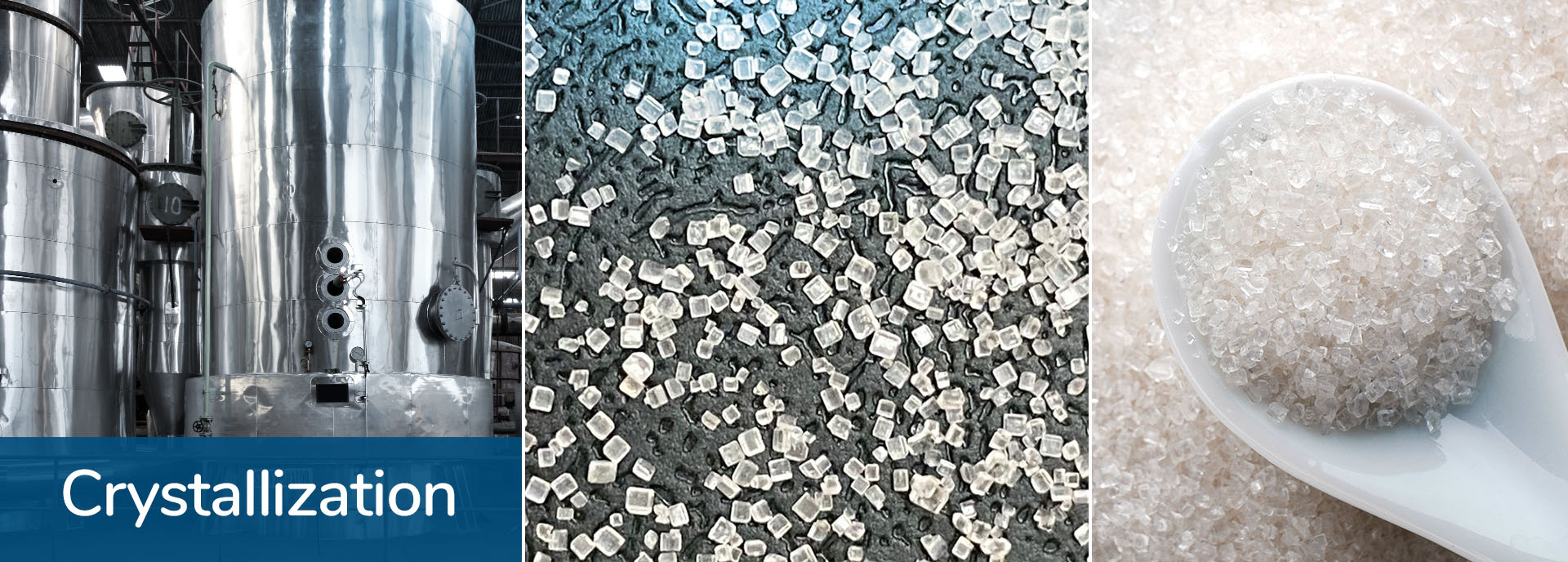
Crystallization is a key process step in sugar production. The aim is to crystallize sucrose from a supersaturated sugar solution in a controlled manner and obtain a crystal population that is as uniform as possible and has the desired properties.
Nucleation, crystal growth and process control are closely interrelated. The initial population of crystal nuclei is just as important as the conditions under which the crystals subsequently grow.
Supersaturation as the Basis for Crystallization
Supersaturation is the driving force for nucleation and crystal growth. It cannot be determined from a single measured parameter. Dry substance content or Brix, temperature and the purity of the sugar solution all influence the conditions under which crystals form and grow.
For controlled nucleation, the sugar solution must be within a suitable supersaturation range when the crystal nuclei are added. If supersaturation is too low, particularly the smaller introduced nuclei may redissolve . If supersaturation is too high, the risk of spontaneous nucleation increases; under actual process conditions, secondary nucleation may also be promoted.
A Defined Initial Population for Reproducible Nucleation
For controlled crystallization, a defined number of crystal nuclei should grow as uniformly as possible. The properties of the seed slurry determine the initial population with which the crystallization process begins.
In addition to particle size and particle size distribution, relevant properties include the proportion of fines, agglomeration behavior, sedimentation rate, homogeneity and viscosity.
MA and CV are among the parameters used in the sugar industry to characterize a crystal population.
The MA value (Mean Aperture) describes the characteristic mean size of a crystal population. The CV value (Coefficient of Variation) describes the relative spread of crystal sizes around this mean. Accordingly, a lower CV indicates a narrower crystal size distribution.
Both values should be considered together. Additional properties are also relevant when assessing a seed slurry.
The size distribution of the seed slurry defines part of the initial population for crystallization. However, there is no direct 1:1 relationship with the subsequent CV of the crystal sugar. How the crystal population develops subsequently depends to a large extent on further process control.
Following nucleation, the existing crystals must continue to grow under suitable conditions. This requires the continuous transport of sucrose from the mother liquor to the crystal surfaces.
As the dry substance and crystal content increase, however, the massecuite becomes more viscous. Particularly at lower purities, non sugars can further intensify this effect.
Natural or mechanical circulation decreases, making heat and mass transfer more difficult. Particularly in low purity massecuites , this can limit further crystallization and also make subsequent processing more difficult.
Improved Circulation Supports Heat and Mass Transfer
Improved circulation supports heat and mass transfer within the vacuum pan. This can create more favorable conditions for transporting dissolved sucrose to the existing crystal surfaces and for further crystal growth.
Depending on the massecuite and process conditions, improved flow behavior can also allow higher final concentrations and facilitate the subsequent separation of crystals and mother liquor in the centrifuge.
In sugar crystallization, nucleation, crystal growth and process control are closely interrelated. KEBO offers process aids for two key stages: the controlled introduction of crystal nuclei and the conditions required for subsequent crystal growth.
KEBO SLURRY for Controlled and Reproducible Nucleation
KEBO SLURRY is a ready to use seed slurry consisting of finely dispersed sucrose particles in a dispersion liquid. Defined particle properties, a low tendency to agglomerate and a low sedimentation rate provide favorable conditions for the controlled and reproducible addition of crystal nuclei.
The properties of the seed slurry define the initial population. How the crystal population subsequently develops is influenced to a large extent by further process control.
KEBOSOL RA for Improved Circulation as Viscosity Increases
As the crystal and dry substance content increase, the viscosity of the massecuite rises. This can increasingly impede circulation as well as heat and mass transfer.
KEBOSOL RA improves the flow behavior of the massecuite , thereby supporting circulation. This can create more favorable conditions for heat and mass transfer and for further crystal growth.
Learn more about the relationships between nucleation, crystal growth, MA/CV, supersaturation and viscosity on our dedicated sugar crystallization page.
A defined seed slurry provides the starting point for crystallization. However, it does not by itself determine the properties of the subsequent crystal population.
Supersaturation, temperature, purity, dry substance content and circulation, as well as possible dissolution of crystal nuclei and unwanted additional nucleation, influence the further development of the crystals.
Controlled crystallization therefore begins with a defined initial population and subsequently requires suitable and, as far as possible, stable process conditions.
Adapting Crystallization to the Specific Process
Raw material, purity, crystallization stage, plant configuration and process control vary from one factory to another. Process aids and their application therefore need to be adapted to the specific conditions.
Our chemists and application specialists support you in assessing your specific crystallization conditions and in selecting and applying suitable process aids.
Discuss your application with our experts send us an email via our contact page.
The conditions for crystallization are already influenced by upstream process stages. Deposits in evaporator stations, for example, can impair heat transfer and make plant operation more difficult.
KEBO DS is an antiscalant for evaporator stations in the food industry. Its application therefore begins upstream of the actual crystallization process.

The products shown on our website are only a selection of our entire product range. There is no universal remedy for the rapid removal of impurities. Some can be removed well with alkaline agents, others better in the acidic range. The large variety of conceivable cleaning problems and the large number of additives, inhibitors and ready-to-use cleaning solutions offered by us make it advisable to obtain detailed advice before starting cleaning.
The same applies to inhibitors, defoamers, scale preventers, corrosion inhibitors, pickling inhibitors, etc. Depending on the plant, material, product and the type of boiler/cooling water is used, different individual challenges arise. We are well equipped for them.
Talk to us, we will be happy to help!
On request, we can analyze deposits in our laboratory and develop a cleaning strategy based on our many years of experience, taking into account the conditions on site.